
Automatic Fish Feeder Guide: Best Types & Setup Tips
A practical guide to automatic fish feeders — how they work, which type suits your tank, setup steps, common mistakes, and feeding schedules by fish type.

✓Recommended Gear
If a trip is coming up, you might be staring at your tank and wondering who will feed your fish — you're not alone. Thousands of fishkeepers search for this same solution every year. An automatic fish feeder solves the problem. In 2026, these units are more reliable and more affordable than ever.
Quick Answer: An automatic fish feeder drops a pre-set amount of food on a timer. Your fish eat on schedule even when you're not home. Most battery-powered units cost $15–$40. A full hopper lasts 2–4 weeks and works with flakes, pellets, or crushed food. For most home aquariums, a simple programmable feeder with a rotating drum gives you the best mix of price and reliability.

Why Fish Owners Use Automatic Feeders
An automatic feeder solves one problem: it keeps your fish fed on a steady schedule when you can't be there. This matters most on vacation. It also helps on busy weekdays when you're rushing out the door.
Fish don't need constant attention, but they do need consistency. Skipped meals followed by overfeeding to "make up for it" stress fish and foul the water fast.
- Vacation coverage: skip asking a neighbor to overfeed your tank
- Consistent portions: cuts down the ammonia spikes that come from guesswork feeding
- Multiple daily feedings: fry and other small fish do well on 3+ small meals a day, which isn't practical on a human schedule
Pro Tip: Leaving for more than 4-5 days? Do a partial water change and clean your filter media before you go. A stable tank handles a feeder's minor food buildup much better than a tank that's already borderline on water quality.
Research on captive fish feeding shows that regular, moderate feeding supports better growth and lower stress than irregular feeding [1]. That's the real case for automation. It's not just about convenience — it's about giving your fish a stable routine.
How Automatic Fish Feeders Work
Most automatic feeders use a rotating drum or a screw auger to release measured food at set times. You load dry food into a hopper, set a timer, and the unit handles the rest.
There are three common types on the market:
- Rotating drum feeders — a wheel with small compartments spins and drops food through a chute at each interval
- Auger/screw feeders — a small motor turns a screw that pushes food out gradually; this works well for finer or crushed food
- Belt feeders — less common, used mostly on ponds and large tanks, where a conveyor spreads food across the surface
Most battery-powered units run on 2 AA batteries and last 1–3 months per set. Look for a feeder with a desiccant chamber. This small compartment absorbs humidity and stops food from clumping and jamming the mechanism.
If flakes are your main food, check compatibility first. Flake food is lighter than pellets, so it jams more easily. A feeder built for flakes, with an anti-clump design, works far better than a generic pellet feeder. Our automatic fish feeder guide breaks down which mechanisms handle flakes best.
Best Automatic Feeders by Tank Situation
The right feeder depends on your tank size, your food type, and how long you'll be gone. A feeder built for a 10-gallon nano tank isn't right for a 55-gallon community tank. A pond needs a different design altogether.
Small tanks need small, precise doses. Too much food fouls a small water volume fast. Large tanks and ponds need bigger hoppers. They also benefit from adjustable dispensing angles, so food spreads across a wider surface instead of dumping in one spot.
| Tank Type | Best Feeder Type | Hopper Size | Best For | Recommendation |
|---|---|---|---|---|
| Nano/small tank (under 10 gal) | Compact drum feeder | Small (single-meal doses) | Bettas, small community tanks | Best for precision |
| Standard tank (20–55 gal) | Programmable drum feeder | Medium, multi-week supply | Most home aquariums | Best overall pick |
| Large aquarium (75+ gal) | Auger feeder with wide dispersal | Large hopper | Cichlids, larger community tanks | Best for volume |
| Pond | Weatherproof belt/auger feeder | Extra-large, weather-sealed | Koi, goldfish ponds | Best for outdoor use |
For a standard home tank, the Eheim Twin Automatic Fish Feeder is a solid, widely used option with two independent dispensers. That's handy if you keep two food types or two tanks side by side.
Common Myth: "Automatic feeders overfeed fish and cause algae blooms." Reality: Overfeeding happens when the portion size is set too high, not because the feeder is automatic. A correctly calibrated feeder actually cuts overfeeding compared to manual feeding. It removes the human habit of adding "just a little extra" [2].
Short on time and just need something reliable? Check out our budget-friendly auto feeder picks →
Setting Up Your Feeder Correctly
A feeder is only as good as its setup. A few small mistakes at install can undo all the benefits of automation, so take ten minutes to do it right.
First, mount the feeder securely above the waterline, on the rim or lid of your tank. Most units use an adjustable bracket or clip. Make sure it's tight — a feeder that slides or tips into the water ruins the food and can damage the motor.
Next, load fresh, dry food. Don't overfill the hopper past the max line, and don't mix wet or oily food in, since it clumps and jams the mechanism. If you're switching from flakes to pellets, run a test cycle first to make sure the new food dispenses cleanly.
Set your feeding times to match your fish's normal schedule — usually once or twice a day, at the same times you'd normally feed by hand. Most units, like the Fish Mate F14 Automatic Fish Feeder, let you program up to 4 feeding times with a simple dial or digital display.

Finally, test the feeder for a few days before you actually leave. Watch a full cycle, check the portion size, and adjust down if you see leftover food after 5 minutes. A short test run catches problems while you're still around to fix them.
Common Mistakes to Avoid
Most feeder failures come down to setup, not the device itself. Here are the mistakes that trip up new users most often.
- Overloading the hopper: too much food packed in tight can jam the drum or auger
- Skipping the test run: an untested feeder is a gamble on the day you're not there to check it
- Ignoring humidity: food left in a humid, bathroom-adjacent fish room clumps fast, even with a desiccant chamber
- Wrong food type: forcing flakes through a pellet-only mechanism causes most jams
- Weak batteries: swap in fresh batteries before any trip longer than a few days, even if the old ones still show power
For nano tanks or precise, small-dose feeding, something like the EVEBOOM Automatic Fish Feeder handles compact hoppers well without dumping too much food at once.
Feeding Schedule by Fish Type
Not every fish eats the same way, so your feeder settings shouldn't be one-size-fits-all. Match your feeding schedule to your fish, not just your calendar.
| Fish Type | Feedings Per Day | Notes |
|---|---|---|
| Bettas | 1–2 | Small portions; bettas overeat easily |
| Community tropicals (tetras, guppies) | 1–2 | Standard flake or small pellet doses |
| Goldfish | 1–2 | Prone to bloat; keep portions light |
| Cichlids | 2 | Larger pellets; more active feeders |
| Fry/juveniles | 3–4 | Small, frequent meals support faster growth |
| Koi (pond) | 1–2 (seasonal) | Reduce or stop feeding below 50°F water temp |
If you keep a mixed community tank, set your feeder to the most sensitive fish — usually the smallest or slowest eater. Supplement faster eaters by hand when you're home. A feeder built for finer food, like the Zacro Automatic Fish Feeder, works well for tanks that mix flakes and small pellets.
Recommended Gear

Eheim Twin Automatic Fish Feeder
Two independent dispensers let you run two food types or two tanks from one unit, and the drum mechanism resists jamming.
Check Price on Amazon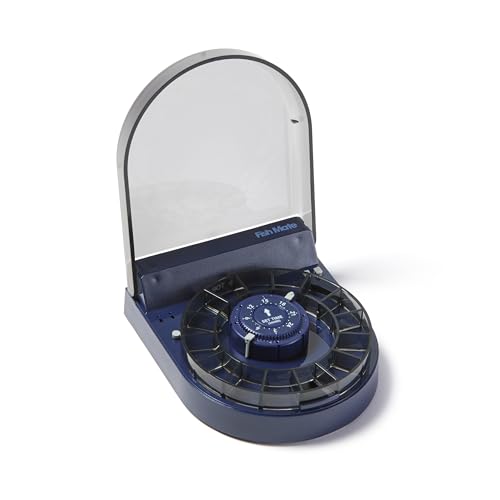
Fish Mate F14 Automatic Fish Feeder
A 14-day capacity and up to 4 programmable feeding times make it a solid pick for vacations longer than a week.
Check Price on Amazon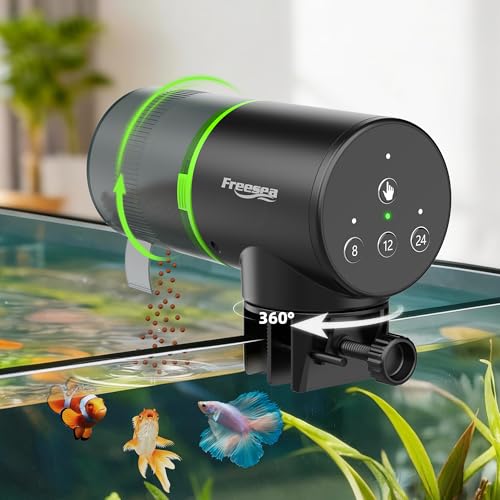
EVEBOOM Automatic Fish Feeder
A compact hopper delivers small, precise doses so you don't overfeed a small water volume.
Check Price on Amazon
Zacro Automatic Fish Feeder
The auger mechanism handles finer, crushed food better than most drum-style feeders, cutting down on jams.
Check Price on Amazon

